


The Weight Was Never the Whole Job. Here's the One Part a Label Can Actually Answer.
You've read why the knee didn't follow the scale. This page does one thing: it shows you which part of that gap a joint formula can address — and gives you four things to check on the back of any bottle, ours included, before you buy one more.
Not medical advice. If you're on a GLP-1, it stays exactly where your doctor put it.
The gap has three parts. Only one of them is a label's job.
You've seen all three by now. Let's be straight about whose each one is.
| The part of the gap | Whose job | |
|---|---|---|
| The weight | You + your doctor | Done — and it matters. Keep doing it, and stay on the medication. |
| The stability | You + your doctor | Muscle around the knee, bone underneath. Protein, strength work, and a conversation about bone. |
| What the joint is fed | A label's job | The fluid it drinks from, and whether what you take was ever built to reach it — the only part a label can address, and the only part we'll talk about. |
What we make is a food supplement. It is not semaglutide, it does none of what the drug did in those studies, and nothing about it is a reason to change a prescription. It speaks to the third row. That's a small, honest claim, and it's the one we make.
Four things to check on the back of any joint formula. Ours included.
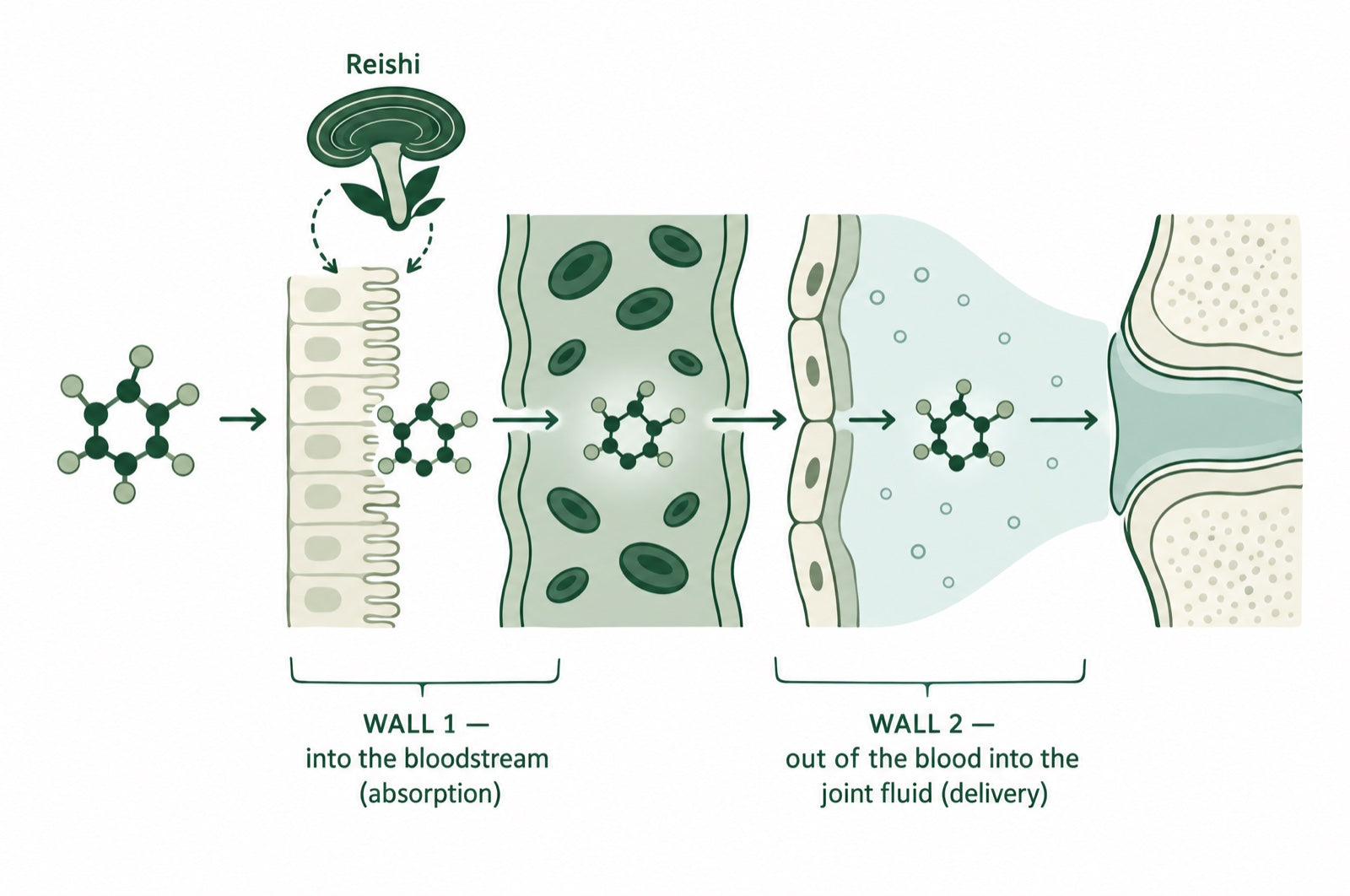
You know the two walls: most of the turmeric in a joint formula is never absorbed at all, and whatever is absorbed still has to make the jump from your blood into the joint fluid — the only room cartilage eats from. Nobody can print the fraction that arrives. But a label can answer four questions, and they're the only four that matter. If a formula fails them, don't buy it. If it passes, it's worth five more minutes.
1. Are the core ingredients at studied doses — or at a sprinkle? The major glucosamine trials used 1,500 mg a day. Many labels list 500 mg, or hide the number inside a "proprietary blend." The back of the bottle tells you more than the front.
2. Is the turmeric paired with anything for absorption? Wall one. If a formula leans on turmeric and pairs it with nothing, ask why.
3. Does it do anything for bone and muscle — the two things the clinics are watching? The stability row is your doctor's. But vitamin D3 contributes to normal muscle function and the maintenance of normal bones, and calcium contributes to the maintenance of normal bones. A joint formula with neither wasn't built with someone on a GLP-1 in mind.
4. Is the routine one you'll actually keep when you're eating less? Not a quality point, a practical one. Five capsules from three tubs is the first thing that quietly stops happening when you're eating half of what you used to.
Flexa against the four checks.
Every line below is printed on the back of the bottle. Hold your old label next to it.
| Ingredient | Per daily serving | Which check it answers |
|---|---|---|
| Glucosamine | 1,500 mg | Check 1 · The daily amount used in GAIT and MOVES — not 500 mg, not a blend. |
| Chondroitin | 800 mg | Check 1 · Paired with glucosamine in the trials; helps cartilage hold water. |
| MSM | 1,000 mg | Check 1 · A sulphur compound with its own placebo-controlled knee trials. |
| Turmeric | 200 mg | Check 2 · The comfort compound — and not left to be poorly absorbed on its own. |
| Reishi | included | Check 2 · The absorption partner for the turmeric. The pairing most formulas skip. |
| Vitamin D3 | included | Check 3 · Contributes to normal muscle function and the maintenance of normal bones. |
| Calcium | included | Check 3 · Contributes to the maintenance of normal bones. |
| The routine | 2 gummies | Check 4 · One formula, two gummies with breakfast. Not four tubs. |
Built for the two walls. Nothing else.
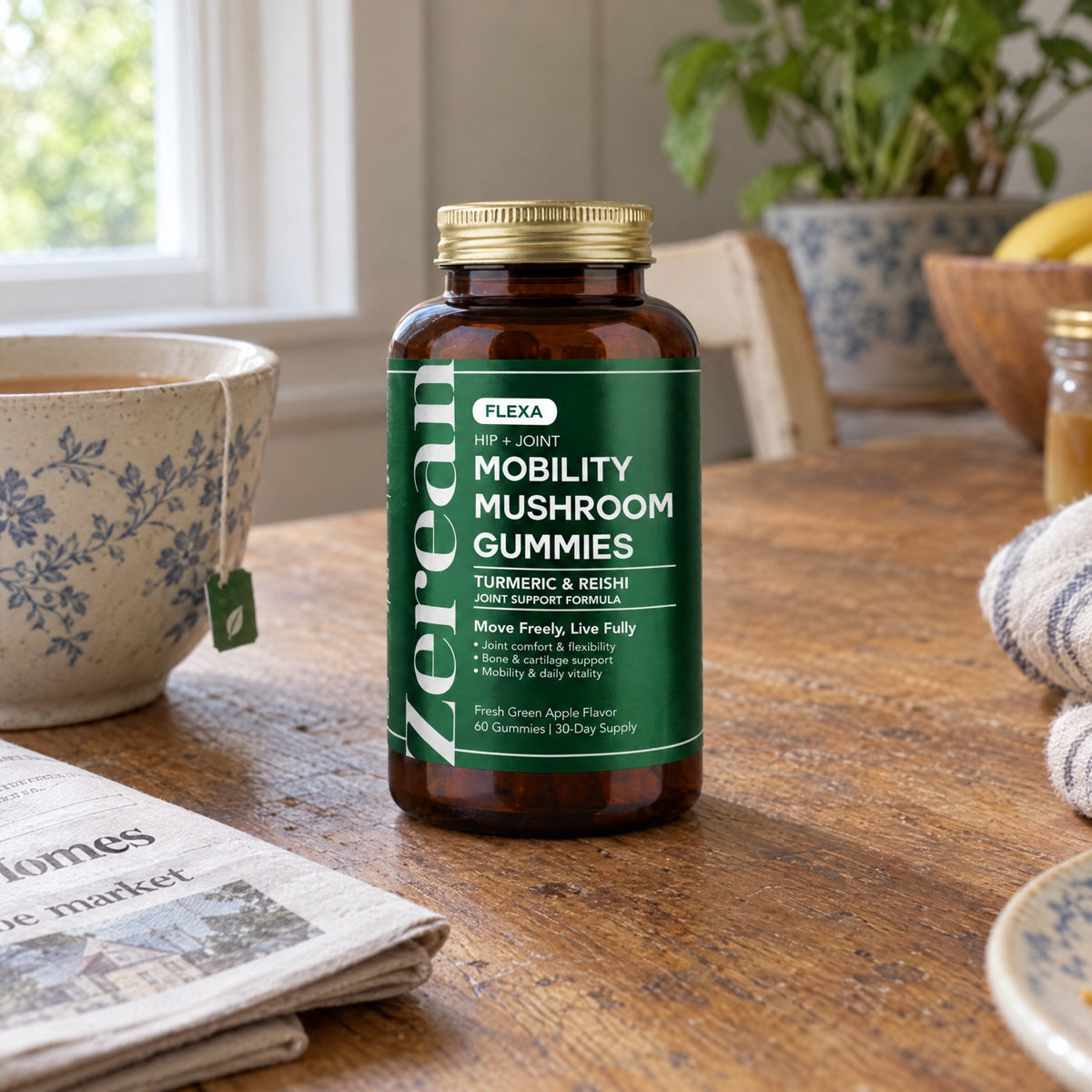
The doses are the trial doses. The turmeric is paired with Reishi rather than left on its own — in our own testing, that pairing raised curcumin absorption by up to 99× versus turmeric alone. D3 and calcium are in for the two things the clinics watch. And it's two gummies, so it's a routine that survives a smaller appetite.
Flexa is a food supplement. It's raw material for the joint, not a painkiller, and it doesn't regrow cartilage — nothing you can buy does.
Glucosamine and chondroitin were tested in GAIT (NIH-funded, 1,583 people, 1,500 mg glucosamine a day; overall result against placebo not significant, moderate-to-severe pain group showed a signal) and in MOVES (606 people, six months, head to head against celecoxib, comparable results). Those trials tested the ingredients, not any finished product — ours or anyone's. Which is exactly why the label is the thing to compare.
The studies referenced above
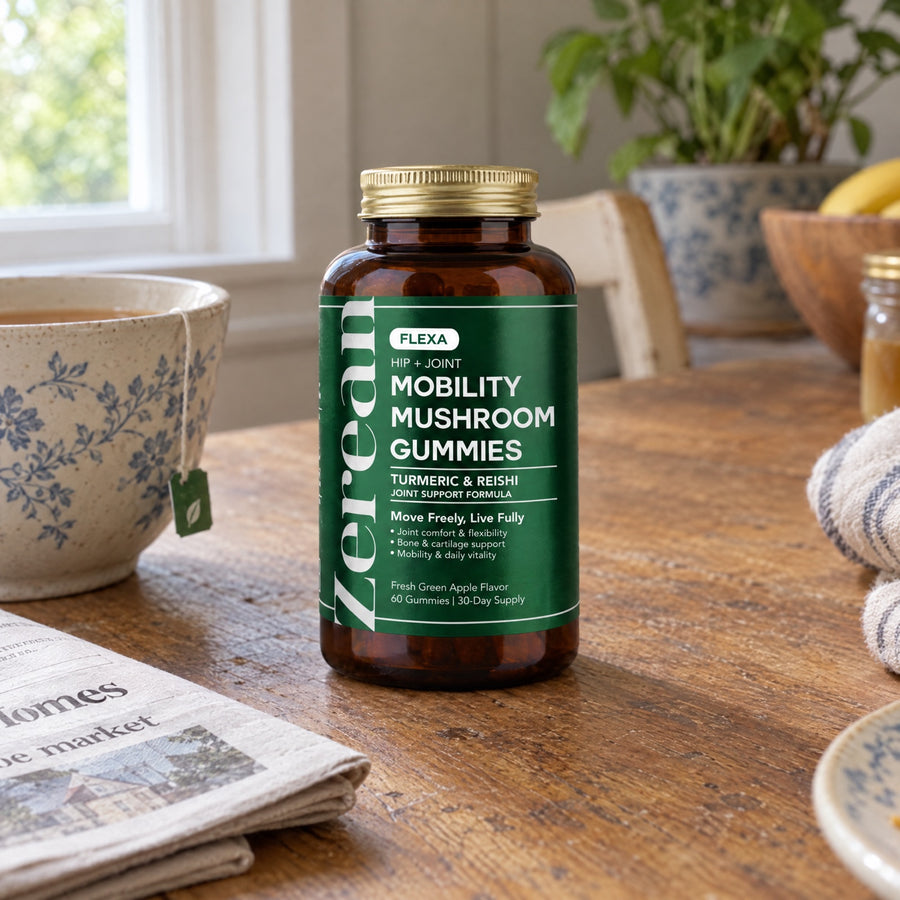
Your first bottle, 54% off
Subscribe & Save prices, billed each cycle until you pause or cancel — you can do either any time. Prefer a one-off? One-time purchase is $38.56 a bottle on the same page. Free shipping on orders over $80. Regular price $64.99.
4.7 on Trustpilot · GMP-Certified · Third-Party Tested
Judge it at twelve weeks. Not at three.
You can't feel cartilage being fed in an afternoon. Glucosamine, chondroitin and MSM are raw material, not painkillers — delivered daily, doing quiet work over weeks. Most people who say a joint supplement "did nothing" stopped in week three, before anything had a chance to happen.
Weeks 1–2: expect nothing you'd swear to. Weeks 3–5: if anything shifts first, it's usually an everyday thing — the step, the car door — not a pain score. Weeks 6–12: the stretch that matters. Take stock here, with the everyday things, not on any single morning.
Individual results vary.
Questions people ask before their first bottle
Flexa is a food supplement — glucosamine, chondroitin, MSM, turmeric, Reishi, vitamin D3 and calcium. Most people take it with breakfast. But you're on a prescription, so ask your doctor or pharmacist before adding anything, and don't change your medication because of an article. We'd rather you asked.
No. Those studies were of a prescription drug, and the cartilage findings are early — mice and a 20-person pilot. Flexa supplies raw material the joint is built from, at studied doses, in a formula built with the two walls in mind. That's a different and much smaller claim, and the only one we make.
There can be a few reasons a past supplement didn't help — dose, form, absorption, or simply not being a fit for you. Rather than guess which, hold your old label up against the four checks above and compare. That's what they're for.
It isn't a painkiller and we won't pretend otherwise. It supplies the material cartilage is built from. That's a slower, different thing than muting a signal — and the thing to watch is the step, not a pain score.
The prices above are the Subscribe & Save ladder — a bottle every 30 days, billed each cycle until you pause or cancel, which you can do any time from your account. If you'd rather buy once, choose One-time purchase on the product page: $38.56 for a bottle, $71.98 for two, $104.10 for three.